
Most educators agree that there should be some guardrails regarding how students use AI in their independent work. Here, I argue for this guiding principle: Students should only use AI for things that they already know how to do well.
A story is told about Harold Alexander, British field marshal in command of the evacuation at Dunkirk. At the end of the workday he had the habit of taking any correspondence still in his “in” tray and simply putting it in the “out” tray. When his assistant once asked about it, he said “You’d be surprised how little of it comes back.”
That sums up my approach to the winds of educational change. When a new technology appears and people are asking themselves “what about my teaching should change?” my instinct for my own teaching is “change nothing,” partly because I suspect that the excitement is overblown, and partly because I’m happy to let more venturesome people make a change first, and learn from their experiences.
But that strategy can’t be applied in the case of AI. In 2023 I, like every other educator, realized that I had to respond to student access to large language models.
Administrators have had a few years to think through how teachers should change classroom practice to meet the new reality, and many districts have posted guidelines. The policies I have seen have much in common, and I think they are wrongheaded.
(Throughout this post I’m referring to students’ independent use of AI, not to educational software nor to teachers using AI in their work.)
There seems to be widespread agreement that there’s a problem, and even on how to characterize it. Learning is a product of engaging in mental work, and students may use AI to replace that mental work and hence, not to learn. The question is what to do about it.
Almost no one advocates for “no restrictions on independent AI use” nor for “No independent AI use by students. Period.” The overwhelming majority have taken the position that students should use AI, but there should be limits.
Mashable recently ran an article summarizing the response of the US’s largest school districts. Here are the one-sentence versions, as I read them:
New York City: students are allowed to use AI for basic “research, exploration, and creative projects.” There must be educator oversight.
Los Angeles: No AI use under age 13. Over 13, students can use AI to brainstorm and to edit their text, but students must produce text. Students must cite what AI contributed.
Chicago: Students can use AI for tasks like brainstorming and summarizing. They are encouraged to use AI as a study partner.
The policy of my home county (Albemarle, Virginia) is similar. There are published categories of AI support from which teachers may choose.
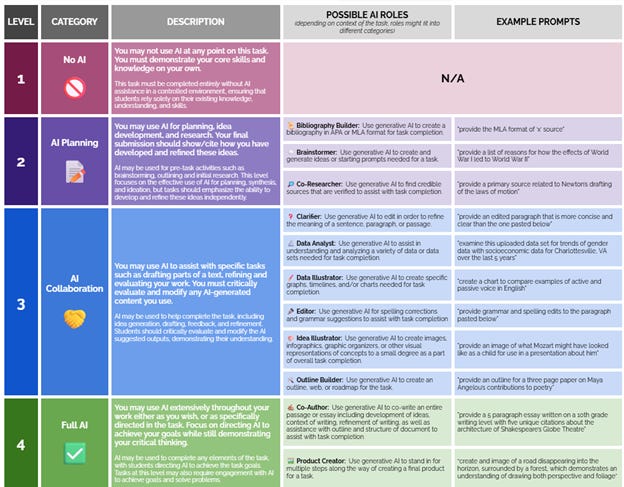
In short, teachers are given a good amount of leeway to allow students to use AI or to forbid it. There is, however, little or no guidance about how that choice should best be made.
These policies share a vibe. The goal is that students use AI as an associate in their work, but the student is still very much the lead. The second goal is that students be honest about exactly what AI has contributed.
This lead/associate orientation makes sense for life after graduation. Once a student is in the workforce, they will use AI to produce products: new ideas, reports, and so on. A guiding principle of “Use AI, but let me see your work” makes sense.
This is not, however, an optimal guiding principle for students. Students produce products, but the product is seldom the point. No one wants to read the papers they write, and the math problems they solve have no practical value. Teachers have them do these tasks because they provide practice in cognitive abilities that we think matter.
Writing is an especially interesting example. Writing a substantial paper requires integrating what you know across multiple sources, formulating a detailed argument, articulating your thoughts precisely, anticipating what your reader knows and can understand, and more.
For many educators, writing papers was the only tool we had to ensure that students engage these cognitive processes. AI took that tool from us, and we don’t know of a good replacement.
This loss was unprecedented. The closest analog might be math problems and calculators or Google Translate for foreign language. But in those cases a teacher could still remind students that they would not have these tools available during in-class assessments. I can’t give my students an in-class assessment that is cognitively comparable to writing a ten-page paper.
So the point of assignments is the mental processes required to complete them, and the point of the mental processes is learning. That seems to suggest a simple litmus test for the use of AI. Artificial Intelligence tools should not substitute for tasks wherein students would benefit from doing the mental work themselves.
So…do students learn when they brainstorm? Do they learn when they edit their work? Of course they do. This principle indicates that students should use AI only when doing the work themselves would yield little learning. This guideline echoes how most of us think about calculator use. Once you’ve mastered arithmetic operations, there’s no benefit to hand calculations when you’re solving an algebra problem. But if you’re still learning algebra, don’t use the algebraic functions. The slogan might be:
“Only use AI for what you already know how to do.”
I can see two objections.
First, can’t AI scaffold learning? Part of the learning process is doing things badly. Can’t AI offer pointers for improvement?
I see two problems with this idea. The first is that the novice is not going to be a very good partner to AI in learning. The novice doesn’t know enough to ask good questions. He will give the AI system a vague prompt about the goal of the exercise whereupon AI will sharpen it for the user. Essentially, it will chivvy the user toward the polished product, and the novice will simply accept the suggestions. (Remember, I’m talking about independent use of LLMs, not about a product custom-made to provide instruction. That’s a different matter.)
The second problem I see with AI-as-scaffold is motivational. Sure, students could learn from AI by asking it to critique their work, to generate counterarguments, and so on. And I’m sure some would, some of the time. But I think it’s asking a lot of students—or better, asking a lot of human nature—to expect them to take a much harder mental path for a project in a typical curriculum, even if it is in the interest of their own learning.
A second objection to the principle might be this: even after you reach competence, you still need practice; that will deepen and refine the skill and/or knowledge. For example, if a ninth-grader can write a good paragraph, is it now okay for AI to write paragraphs for the student?
If students are competent, a teacher should ask whether doing the task themselves is still part of what students are meant to learn or practice. When students are writing, editing, reasoning, problem solving, or brainstorming (for example), the mental process is usually the thing. You don’t want the help of AI because it replaces the mental work that contributes to learning.
The alternative is that AI is replacing a task that merely supports the actual mental work you want the student to do; the replaced task was soaking up the students time and energy and providing no benefit. That would be the college student hand-calculating long multiplication problems required for her engineering problem set.
For this reason I add the word “well” to the candidate principle: “Students should only use AI for things that they already know how to do well.”
Now of course there’s a judgment to be made here. A physics teacher might think “It’s great that AI will polish my students’ writing for their lab reports“ whereas someone else might argue “your students need to learn to write in your class too.” But of course this problem is not new. We’re just seeing the issue in a new guise.
We’ve all heard “They’re going to have to learn to use AI.” But I think that slogan applies to how students will use AI at home and in the workforce, where the product is the thing. For students, learning is the thing. That’s how I come to the principle, “Students should only use AI for things that they already know how to do well.”
That should mean very little use then!
I love this:
We’ve all heard “They’re going to have to learn to use AI.” But I think that slogan applies to how students will use AI at home and in the workforce, where the product is the thing. For students, learning is the thing.
I may try to fit that on a bumper sticker!